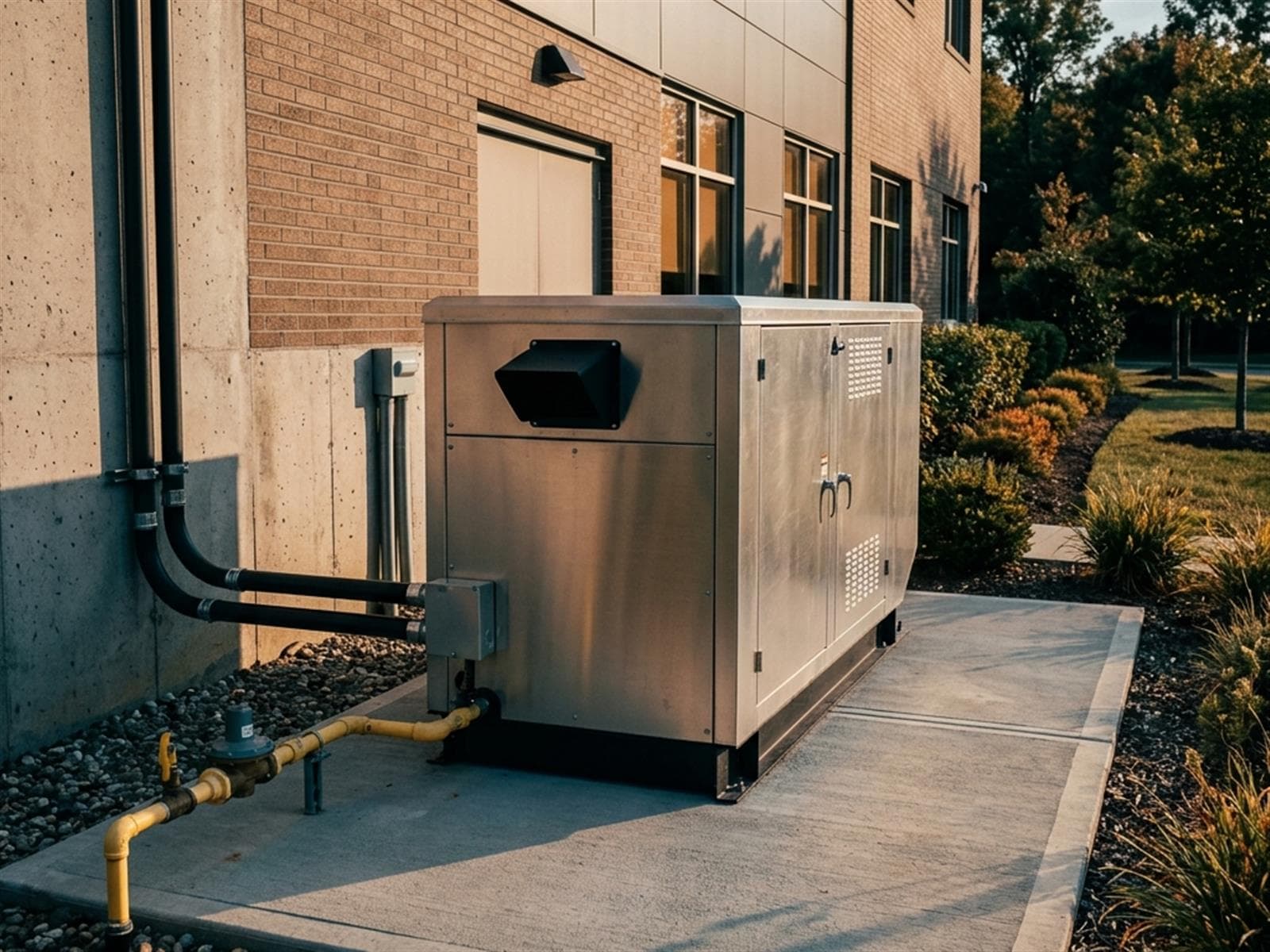
A standby generator gets most of the attention, but the automatic transfer switch is the part that decides when the generator runs and what it powers. It is also the part that keeps generator power off CenterPoint’s lines. Every standby generator Solivance Electric installs in Houston has one.
This post covers what the switch does, how it works, the code that governs it, and the choices that come up when a switch is specified.
What does an automatic transfer switch do?
An automatic transfer switch (ATS) watches utility power. When the utility drops, it starts the generator, waits for stable voltage, and moves the load to the generator. When the utility returns and holds, it moves the load back and lets the generator cool down. At no point can the generator and the utility connect to each other.
What happens during an outage, step by step?
- Utility sensing. The switch monitors voltage on the utility side continuously.
- Outage confirmed. A short delay rules out a blink. Brief sags during a storm do not start the generator.
- Start signal. The switch tells the generator to start.
- Warm-up. The generator comes up to speed and its voltage and frequency stabilize.
- Transfer. The switch disconnects from the utility and connects to the generator. The house or building is back on.
- Utility return. The switch sees utility voltage return and waits to confirm it is stable.
- Retransfer. The load moves back to the utility.
- Cool-down. The generator runs unloaded for a few minutes, then shuts off and returns to standby.
From outage to restored power is typically seconds to under a minute. The house is dark for that window, so computers and network gear still benefit from a small UPS.
Why does the code require one?
NEC Article 702 covers optional standby systems — the category most home and small business generators fall into. It requires transfer equipment that prevents the generator and the utility from ever being connected together. There are two reasons.
The first is backfeed. A generator connected to a house wired to the grid pushes power back out through the meter and the service drop. The transformer on the pole steps that voltage back up, and a line crew working on what they believe is a dead line can be injured or killed. This is why plugging a portable generator into a dryer outlet is dangerous and illegal.
The second is equipment damage. When utility power returns to a house that is still connected to a running generator, the two sources fight. The generator loses.
What kinds of transfer switches are there?
| Type | Where it sits | What it covers |
|---|---|---|
| Service-rated ATS | Between the meter and the main panel | The entire service, typically 200A on a house |
| Non-service-rated ATS | After the main breaker, feeding a subpanel | An essential-circuit subpanel |
| Manual transfer switch | Next to the panel | Selected circuits; someone flips it by hand |
| Interlock kit | On the main panel cover | Used with portable generators; manual only |
A standby generator nearly always pairs with an automatic switch. Manual switches and interlocks are for portable generators, which is a different setup with different safety concerns.
What does a service-rated switch change?
A service-rated ATS has a main breaker built in and is listed as service equipment. It replaces the role of the main breaker for transfer purposes, which means the whole house can move to the generator. On many Houston houses, it mounts outside next to the meter.
That outdoor location matters under the 2023 NEC. Section 230.85 requires an emergency disconnect outside one- and two-family dwellings, readily accessible to first responders. A service-rated transfer switch mounted outside can serve as that disconnect, so the generator install brings the house into compliance at the same time.
How does load management work inside the switch?
A whole-home transfer switch does not have to send every load to the generator at once. Load-shed modules connect to large loads — a second AC condenser, an electric dryer, a pool pump, an EV charger — and hold them off when the generator is near its limit. When there is capacity, the switch lets them run.
NEC 702 allows this automatic load management as a way to size the generator. It is how a right-sized generator covers a house in the Memorial Villages with three AC systems. The trade-offs between whole-home and partial coverage are in whole-home vs. essential-circuit generator.
What does Solivance Electric check when installing the switch?
- Amperage match. The switch rating matches the service or subpanel it feeds.
- Neutral and grounding. The neutral and the grounding are bonded correctly for the switch type and generator, per NEC 250 and the manufacturer.
- Conductor sizing. Generator conductors sized for the generator’s output and the run length, per NEC 445.
- Control wiring. Start and sensing wires run and terminated so the switch and generator talk to each other.
- Load-shed wiring. Modules connected to the right loads and tested.
- Labeling. Required signage at the service and the switch so a first responder or inspector knows a generator is on site.
- Test transfer. The switch is put through a full transfer and retransfer under load before the inspection.
How is a commercial transfer switch different?
The job is the same on a strip center in Stafford or a warehouse in Southwest Houston: keep the generator and the utility apart, and move the load when the utility drops. The equipment and the decisions get larger.
- Three-phase service. Commercial switches are often three-phase, at 208V or 480V, and sized for 400A and up.
- Which loads go on standby. A business usually puts refrigeration, POS, network, security, and some lighting on the generator and leaves process loads off.
- Multiple switches. Larger buildings sometimes use more than one transfer switch so different loads can transfer in sequence.
- Code article. Most business generators are optional standby under NEC 702. Life-safety systems fall under NEC 700 and legally required standby under NEC 701, which carry stricter rules.
Our commercial warehouse and commercial center pages cover that work.
Does the switch need maintenance?
The switch has moving contacts and a control board. Most standby generators run a scheduled self-test, and the switch should be exercised under load periodically. Contacts and terminations get checked during annual generator service. Solivance Electric covers that work under our care plans.
Do I buy the switch separately from the generator?
Solivance Electric is an authorized Briggs & Stratton standby generator dealer. The transfer switch is specified with the generator so the controls match and the switch is sized for the service. The current lineup with pricing is on the generators page, and sizing is covered in sizing a standby generator in Houston.
Get the switch specified correctly
Solivance Electric specifies the generator and transfer switch together, pulls the permit, coordinates with CenterPoint where needed, and tests a transfer under load before we leave. Request a site walk or call (832) 965-9964. See the full scope on our generator install page. Financing available through Synchrony — ask about monthly payment options. Subject to credit approval. Details on the financing page.